Geotechnical laboratory testing forms the backbone of safe and reliable construction across Fullerton and greater Orange County. This category encompasses the full suite of analytical procedures performed on soil, rock, and groundwater samples to determine their physical, mechanical, and chemical properties. From simple classification tests to sophisticated dynamic analyses, laboratory work transforms field samples into actionable engineering parameters. In a seismically active region like Southern California, where subsurface conditions can vary dramatically within a single parcel, laboratory data provides the quantitative foundation for foundation design, slope stability assessments, and earthwork specifications.
Fullerton's geological setting presents unique challenges that make laboratory testing especially critical. The city straddles the boundary between the Puente Hills and the Los Angeles Basin, underlain by complex sequences of alluvial deposits, weathered sedimentary rocks of the Fernando and Puente Formations, and occasional landslide debris. The Coyote Creek and Fullerton Creek floodplains introduce layers of unconsolidated silts and clays with variable consolidation histories. These conditions demand rigorous testing protocols to identify expansive soils, collapsible materials, and liquefaction-prone layers. The oedometer consolidation test becomes indispensable when evaluating foundation settlements in the compressible alluvium common beneath downtown Fullerton and the industrial corridors along Commonwealth Avenue.
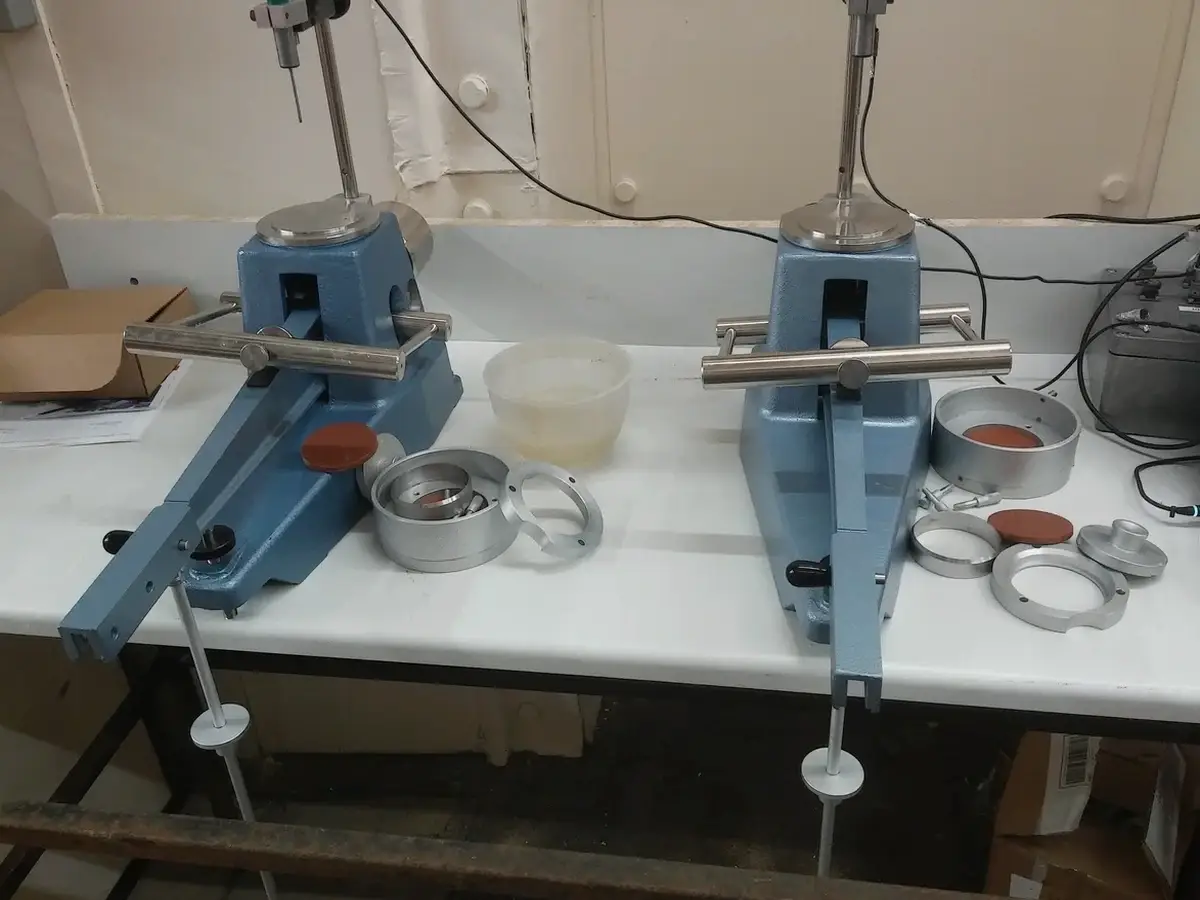
Laboratory procedures in the United States must conform to standards established by ASTM International, AASHTO, and the U.S. Army Corps of Engineers. California imposes additional requirements through Caltrans specifications and the California Building Code (CBC), which incorporates amendments specific to seismic design and expansive soil mitigation. The CBC references ASTM D4318 for Atterberg limits, ASTM D2435 for one-dimensional consolidation, and ASTM D3080 for direct shear testing. Environmental testing often follows EPA SW-846 methods for waste characterization. Fullerton projects falling under the jurisdiction of the Orange County Public Works or the Regional Water Quality Control Board may require specialized leachate testing or corrosion indices beyond standard geotechnical parameters.
The range of projects requiring comprehensive laboratory services spans residential subdivisions in the hills north of Brea Boulevard, commercial developments in the downtown core, and infrastructure upgrades along the State Route 91 corridor. A thorough soil mechanics study typically integrates grain size distribution, compaction characteristics, shear strength parameters, and consolidation behavior to develop a complete geotechnical model. School expansions, hospital retrofits, and public works projects demand the highest level of scrutiny, often including cyclic triaxial testing for liquefaction assessment and resilient modulus determination for pavement design. Forensic investigations following landslides or foundation failures similarly rely on laboratory evidence to establish causative mechanisms and assign responsibility.
Quick answers
What types of tests are typically included in a geotechnical laboratory testing program?
A standard program generally includes moisture content, density, Atterberg limits, grain size analysis, direct shear or triaxial compression, and one-dimensional consolidation. Depending on site conditions and project requirements, additional tests may cover expansion index, collapse potential, permeability, compaction characteristics, organic content, sulfate content, pH and resistivity for corrosion assessment, and cyclic testing for liquefaction evaluation.
How do local soil conditions in Fullerton affect laboratory testing requirements?
Fullerton's alluvial deposits and weathered sedimentary formations often contain expansive smectite clays and compressible silts. Laboratory testing must focus on identifying swell potential, consolidation settlement magnitude, and shear strength under both drained and undrained conditions. Hillside areas may require rock strength testing and durability assessments, while former agricultural or industrial parcels often demand chemical analysis for contaminants.
What certifications should a geotechnical laboratory hold for California projects?
Laboratories should maintain Caltrans accreditation through the Independent Assurance program and demonstrate compliance with ASTM E329 and AASHTO R18 standards. Key certifications include AMRL and CCRL inspections for soils and concrete respectively. For environmental testing, NELAP accreditation through the California ELAP program is essential. Personnel should hold relevant certifications such as NICET or ICC special inspection credentials.
How long does a complete laboratory testing program typically take?
Standard classification and strength tests can be completed within one to two weeks. Consolidation testing requires longer durations due to incremental loading procedures, often extending to two or three weeks per specimen. Specialized tests like triaxial permeability or cyclic liquefaction assessment may require four to six weeks. Rush schedules are available for time-sensitive projects but should be coordinated during the drilling phase to ensure sample integrity.